
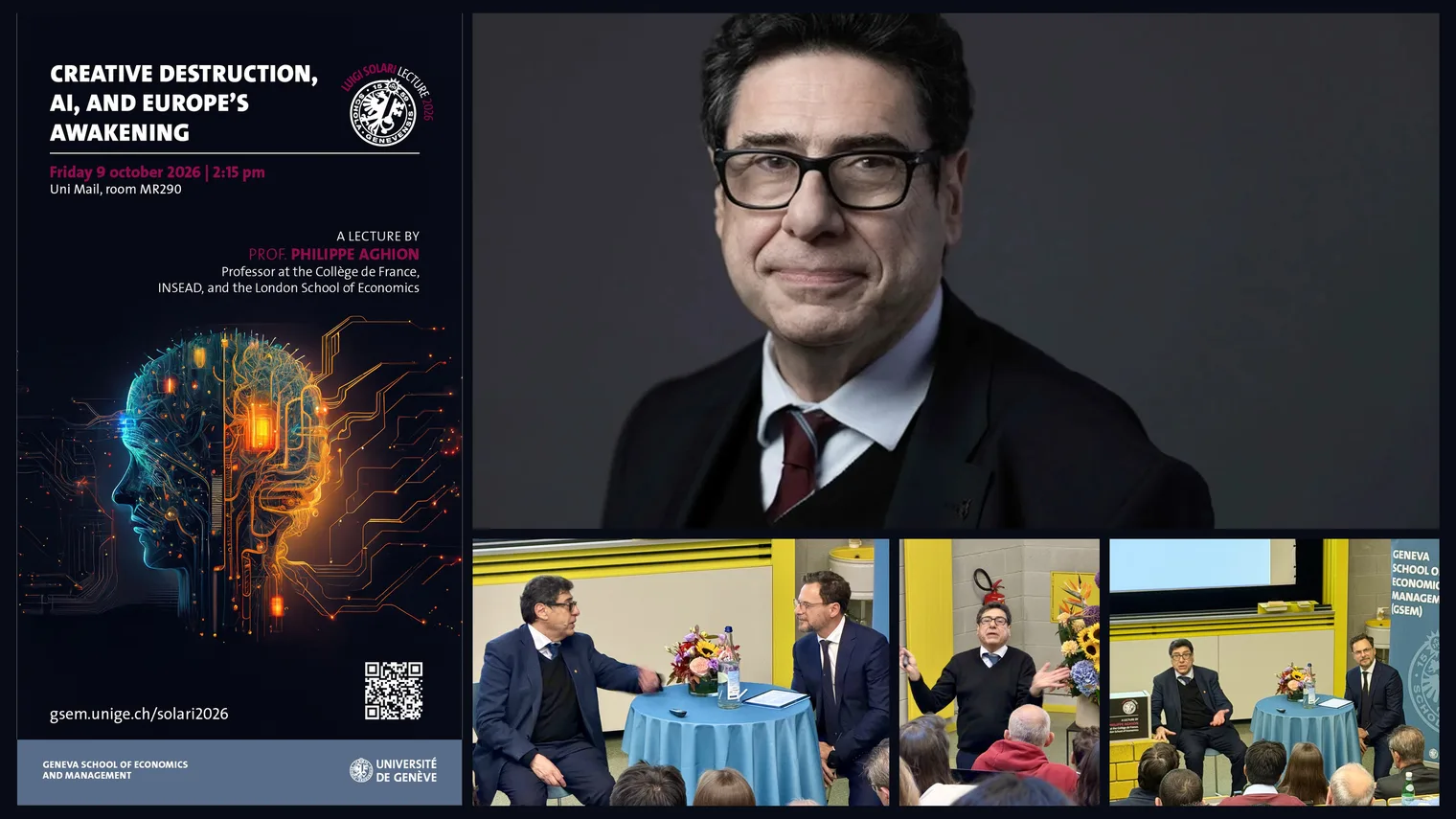
On Friday, 9 October, I had the pleasure of attending Professor Philippe Aghion's lecture at the University of Geneva. This year's Solari Lecture, "Creative Destruction, AI, and Europe's Awakening," offered a fascinating perspective on economic growth, the challenges facing Europe and the possibilities opened by artificial intelligence.
Philippe Aghion is a French economist and professor at the Collège de France, INSEAD and the London School of Economics. He was awarded the 2025 Nobel Prize in Economic Sciences alongside Peter Howitt and Joel Mokyr. Aghion and Howitt were recognised specifically for their theory of sustained growth through creative destruction.
What I particularly appreciated was his ability to make complex economic ideas accessible while connecting them to questions that matter to businesses, governments and individuals. I left with a better understanding of the forces shaping our economy, and with several reflections I would like to share.
The discussion began with a fundamental question: what allows an economy to keep growing?
In the Solow model, production generates income, part of which is saved and invested in additional capital. More equipment, machinery and infrastructure enable an economy to produce more.
However, capital accumulation faces diminishing returns. Giving workers more equipment increases their output, but each additional investment eventually delivers a smaller improvement. Sustained growth in output per person therefore requires technological progress.
The difficulty is that the model does not explain where this progress comes from. It remains, in Aghion's words during the lecture, a "black box."
Opening that box is central to the work he developed with Peter Howitt.
Their approach builds on Joseph Schumpeter's concept of creative destruction and rests on three ideas. Innovation is cumulative: each discovery builds on knowledge developed by others. Innovation is also motivated by the prospect of economic rewards: firms invest in research because success can give them a temporary competitive advantage. Finally, new technologies and products can displace existing ones, making previous solutions obsolete.
Together, these mechanisms help explain how an economy continually renews itself.
They also reveal a tension. Successful innovators need to benefit from their achievements, yet established businesses may subsequently use their resources and influence to prevent new competitors from challenging them.
Aghion described the importance of a balance between innovative firms, a state that protects competition, and a civil society capable of holding both businesses and public authorities accountable. Sustained growth depends partly on keeping the opportunity to challenge established positions open.
This framework offers a compelling way to examine the slowdown in American productivity growth.
The information technology revolution supported a strong acceleration in US productivity growth between roughly 1995 and 2005. Yet that momentum subsequently weakened, even as digital technologies continued to advance.
Aghion's explanation highlights the rise of "superstar firms." Businesses such as Google, Amazon and Microsoft used digital technologies to expand across markets and build powerful competitive positions.
Their expansion initially contributed to productivity growth. But, in his analysis, competition policy failed to adapt sufficiently to their increasing dominance. As the gap between leading firms and potential challengers widened, entering markets and competing successfully became more difficult.
The same businesses that helped drive a technological revolution could therefore contribute to weakening the competitive renewal needed to sustain its benefits. This was one of the most thought-provoking connections in the lecture: technological progress and economic dynamism do not necessarily continue moving together.
A second historical puzzle concerns the transition from catching up to creating what comes next.
An economy can grow rapidly by adopting technologies and production methods already developed elsewhere. Investment, industrial expansion and education allow it to close the gap with more advanced economies.
But as it approaches the technological frontier, the conditions for further growth change. It increasingly needs to generate its own discoveries, support new firms and allow resources to move towards emerging activities.
This distinction helps explain the "middle-income trap": institutions that supported a successful period of catch-up may become obstacles to the next stage of development.
Aghion illustrated this through several historical experiences. The Soviet Union relied heavily on capital accumulation and imitation. In South Korea, large industrial conglomerates played an important role in development, but their influence could also obstruct competition and the emergence of new firms. In his account, the 1997 financial crisis created an opening for reforms by weakening some of that resistance.
He extended the distinction between catching up and frontier innovation to Europe. After the Second World War, Europe achieved remarkable progress through reconstruction, investment, education and the adoption of existing technologies. The transition towards leadership in newer technological industries proved more difficult.
The broader lesson is that the arrangements behind past success may need to evolve as the sources of future growth change.
The comparison between the United States and Europe also raised an important question: can an economy combine innovation with social protection?
Aghion contrasted America's technological dynamism with its greater inequalities and weaker social protection, and Europe's stronger social model with its difficulties in generating and scaling new technological leaders.
His argument was that innovation and inclusion can reinforce each other when the right policies are in place.
He highlighted three priorities. Education allows more people to develop their potential, including those whose background might otherwise prevent them from becoming researchers or entrepreneurs. Competition creates opportunities for new entrants and supports social mobility. And flexicurity, associated particularly with Denmark, combines labour-market adaptability with income protection and support for retraining.
This gives an important human dimension to creative destruction. An economy becomes more capable of change when people have credible support in making the transition.
Artificial intelligence brings these questions into particularly sharp focus.
Aghion identified two channels through which AI can support growth. It can improve the production of goods and services, and it can help generate ideas, accelerating research, discovery and the development of new solutions.
In a study with Simon Bunel, one central estimate puts AI's potential contribution at approximately 0.68 percentage points of additional annual growth in total factor productivity over a decade. That estimate focuses on automating production tasks and excludes the additional contribution AI could make through the generation of ideas. It is a projection based on specific assumptions, rather than an observed economy-wide result.
The possibility of improving how we produce while also expanding what we can conceive is particularly exciting.
Aghion also returned to the question of competition. Access to computing power, cloud infrastructure and other essential resources must allow new businesses to participate. Otherwise, concentration could constrain the very growth that AI makes possible. His support for open-source AI and investment in European capabilities fits into this wider concern.
For me, these arguments lead to two practical reflections about leading a business.
The first is the importance of changing before difficulties force us to do so.
A company can have satisfied customers, healthy financial results and an organisation that functions well, while gradually falling behind. A competitor may already be learning how to use AI, developing its people's capabilities, shortening delivery times and increasing what it can accomplish.
By the time that difference becomes visible in lost contracts or declining margins, the competitor may have accumulated a substantial advantage. The consequences can eventually reach beyond profitability to the company's survival.
From a management perspective, AI represents an additional resource to organise alongside human capabilities and machines. It gives businesses new capacities to analyse, design, coordinate and execute. Leaders need to determine how these resources work together and what they allow the business to undertake.
A company that begins while it is still performing well has more room to experiment, develop skills and make considered choices. It also has a better chance of being among the businesses shaping the next stage of its market.
My second reflection concerns the way we think about productivity and employment.
If we assume that tomorrow's economy will produce exactly the same goods and services, in the same quantities, a dramatic improvement in productivity naturally suggests that fewer people will be needed.
But economic activity is not fixed.
Greater capabilities can make previously uneconomic projects viable, help satisfy unmet needs and allow entirely new activities to emerge. Businesses can develop products they previously lacked the resources to create and address problems they previously could not solve.
Research co-authored by Aghion using French company data offers an interesting illustration: AI adoption was followed by increases in employment and sales at the firm level, although employment effects differed depending on how AI was used. This shows why the relationship between automation and employment deserves a broader analysis than counting the tasks that can be replaced.
Some jobs will disappear and others will change. At the same time, expanding activity can create new roles, while better tools can allow people to take on more interesting responsibilities. Investment, training and the ambition with which businesses use their new capabilities will influence that outcome.
For a business leader, this raises a substantial question: what could our company accomplish with significantly more intelligence at its disposal?
I recognised in Aghion's closing remarks an attitude that resonates with me: understanding the forces at work, taking the challenges seriously and committing ourselves to building the possibilities ahead. His call for a fighting optimism gives an active meaning to the confidence we can have in the future.
My sincere thanks to Professor Philippe Aghion for the clarity of his explanations, the depth of his insights and the enthusiasm with which he shares his knowledge.
Thank you also to the University of Geneva and the organisers of the Solari Lecture for making this encounter possible. Bringing such research into an open conversation is a valuable contribution to the understanding and decisions of students, citizens and business leaders alike.
We are living through an exciting period, with much to learn and much to build.
Selected references
- University of Geneva, Geneva School of Economics and Management, "Solari Lecture 2026 by Professor Philippe Aghion: Creative Destruction, AI, and Europe's Awakening", 9 October 2026. unige.ch
- The Royal Swedish Academy of Sciences, press release, The Prize in Economic Sciences 2025, 13 October 2025. nobelprize.org
- P. Aghion and S. Bunel, "AI and Growth: Where Do We Stand?", June 2024. frbsf.org
- P. Aghion, S. Bunel, X. Jaravel, T. Mikaelsen, A. Roulet and J. Søgaard, "How Different Uses of AI Shape Labor Demand: Evidence from France", AEA Papers and Proceedings, vol. 115, 2025, pp. 62-67. aeaweb.org